


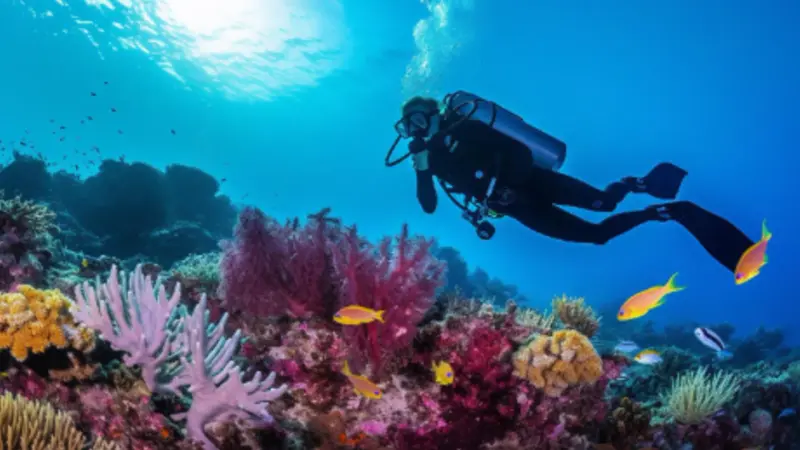
When most people picture scuba diving, their minds immediately drift to shallow, sun-drenched tropical waters filled with vibrant coral reefs, schools of brightly colored fish, and gentle sea turtles. While coral ecosystems are undeniably spectacular, they represent only a tiny fraction of the global aquatic landscape. Beyond the sunlit boundaries of the shallow reefs lies a completely different underwater world. It is a realm of vast geological formations, historic shipwrecks frozen in time, immense vertical drop-offs, and deep structural chasms.
Exploring these deep-water environments requires advanced technical training, specialized equipment, and a high level of mental discipline. For those who possess the necessary expertise, diving beyond the reefs offers an unparalleled sense of discovery. It allows adventurers to witness the raw, dramatic geology of the planet and encounter unique pelagic species that rarely venture into shallow coastal waters.
The Dramatic Geology of Oceanic Blue Holes
Blue holes are massive, submerged sinkholes that form vertical caves plunging deep into the earth. These geological wonders were created thousands of years ago during past ice ages, when lower sea levels exposed limestone landscapes to acidic rainwater. This water carved out deep subterranean cavern systems that eventually collapsed inward. When the glaciers melted and sea levels rose once more, these deep shafts were completely filled by the ocean.
The Great Blue Hole, Belize
While located within a wider reef system, the interior of the Great Blue Hole is a completely separate, non-coral environment. Spanning over 1,000 feet across and dropping to depths of over 400 feet, this site is a true deep-water destination. As divers descend past 100 feet, the ambient sunlight fades into a deep, eerie indigo hue.
The true highlight of this dive occurs around 130 feet, where the vertical limestone wall recedes to reveal a vast cavern filled with massive stalactites. Some of these stone columns measure up to 40 feet in length, hanging silently in the dark water. The lack of current and marine growth gives the cavern a stark, cathedral-like atmosphere, occasionally interrupted by the shadowy silhouettes of deep-dwelling reef sharks or hammerheads patrolling the abyss.
Dean’s Blue Hole, Bahamas
Located in a bay on Long Island in the Bahamas, Dean’s Blue Hole is one of the deepest known marine sinkholes on earth, plunging down to a depth of roughly 663 feet. What makes this site unique is its structural composition. At the surface, the opening is roughly 80 to 115 feet across, but once a diver descends past 60 feet, the chamber opens up dramatically into a massive underwater cavern with a width of nearly 330 feet.
Because the hole is sheltered from strong coastal currents, the visibility inside is exceptionally clear. The walls are composed of bare, sculpted limestone cliffs, offering a surreal experience akin to floating through a subterranean mountain range.
Plunging into the Abyss: Deep Vertical Walls and Drop-Offs
Wall diving represents the closest a human being can get to the sensation of true mountain climbing underwater. These sites occur where continental shelves or volcanic islands drop abruptly straight into the open ocean, creating vertical precipices that extend down into thousands of feet of water.
-
The Cayman Trench, Little Cayman: The famous Bloody Bay Wall on Little Cayman starts at a remarkably shallow depth of just 15 to 20 feet, but it immediately drops straight down into the Cayman Trench, which plunges to a maximum depth of over 25,000 feet. Diving along this wall offers an intense sense of exposure. Looking to one side reveals a solid, vertical face of limestone rock covered in deep-sea sponges, while looking to the other side reveals a vast, featureless void of deep oceanic blue.
-
The Wall at Sint Eustatius: Located in the Caribbean Netherlands, this volcanic island features deep drop-offs shaped by historical lava flows. Instead of traditional limestone, the walls here are composed of dark, dramatic volcanic basalt. These structures feature deep cracks and fissures where large pelagic predators, including barracudas, reef sharks, and eagle rays, gather to utilize the powerful upwelling currents that push nutrient-rich water up from the deep ocean floor.
Ghostly Relics: Historical Wrecks in the Deep Ocean
For many deep divers, the ultimate challenge lies in exploring historic shipwrecks that rest well beyond the limits of recreational diving. These deep wrecks function as artificial islands in otherwise featureless expanses of ocean, attracting unique marine life while preserving moments of human history.
The USS Oriskany, Florida
Known affectionately as the Great Carrier Reef, the USS Oriskany is a massive Essex-class aircraft carrier that was intentionally sunk off the coast of Pensacola, Florida, to create a deep-water artificial habitat. Measuring nearly 888 feet in length, this is the largest vessel ever purposefully scuttled for diving.
The sheer scale of the ship means it can only be fully appreciated by technical divers. While the topmost tower structure sits around 80 feet, the vast flight deck rests at a depth of 145 feet, and the hull drops down past 200 feet. Diving this site feels like exploring a ghost city. The massive elevators, radar platforms, and gun turrets are completely intact, attracting large schools of amberjack, pelagic sunfish, and massive sand tiger sharks that cruise across the empty flight deck.
The Ghost Fleet of Truk Lagoon, Micronesia
During World War II, Truk Lagoon in the Central Pacific served as the main forward base for the Imperial Japanese Navy. In 1944, an Allied military strike sunk dozens of warships, merchant vessels, and aircraft inside the lagoon. Today, this site is recognized as one of the premier wreck diving destinations on earth.
While some wrecks are accessible to recreational divers, the most pristine and historically significant ships rest in the deep, dark outer waters of the lagoon at depths between 130 and 230 feet. Wrecks like the San Francisco Maru remain completely loaded with war cargo. Technical divers exploring these deep cargo holds can view rows of light tanks, trucks, crates of ammunition, and torpedoes, all perfectly preserved by the cold, low-oxygen conditions of the deep lagoon floor.
Navigating Volcanic Subterranean Caverns and Tectonic Rifts
Some of the most spectacular deep diving sites are completely devoid of both coral and sunlight, focusing entirely on the raw tectonic forces that shape the outer crust of the planet.
Silfra Fissure, Iceland
Silfra is a flooded tectonic rift located in Thingvellir National Park in Iceland. It is the only place in the world where individuals can dive directly into the narrow gap between the North American and Eurasian tectonic plates. The rift is fed by glacial meltwater that has been filtered through porous underground volcanic basalt rock for decades.
This intense filtration process makes the water exceptionally pure, resulting in horizontal visibility that routinely exceeds 300 feet. The water temperature hovers consistently between 35 and 39 degrees Fahrenheit year-round, requiring specialized drysuits and cold-weather gear. There is virtually no animal life inside the fissure. Instead, divers navigate through a narrow, deep chasm of raw, blocky volcanic rock, experiencing the unique sensation of floating between two shifting continents.
Frequently Asked Questions
What is the primary difference between recreational diving and technical deep diving?
Recreational diving is strictly limited to a maximum depth of 130 feet, and divers must always maintain a direct, vertical path to the surface in case of an emergency. Technical deep diving involves descending past 130 feet or entering overhead environments like deep caves and shipwrecks. Technical divers cannot ascend directly to the surface because their bodies have absorbed significant amounts of nitrogen; they must perform scheduled decompression stops during their ascent to prevent decompression sickness.
What kind of specialized gas do deep-sea divers breathe instead of regular air?
As divers go deeper, the high pressure causes regular air to become toxic. The high concentration of nitrogen triggers nitrogen narcosis, a condition that impairs judgment, while oxygen becomes toxic to the central nervous system past certain depths. To counter this, deep divers use a specialized gas mixture called Trimix, which blends oxygen and nitrogen with helium. Helium is an inert gas that does not cause narcosis, allowing divers to maintain a clear mind at great depths.
Why are deep-sea shipwrecks often better preserved than those found in shallow water?
Shallow-water shipwrecks are constantly subjected to strong wave action, coastal currents, high oxygen levels, and warm water temperatures, which accelerate the physical breaking apart of structures and speed up chemical rust. Deep-sea wrecks rest in calm, cold environments with low oxygen concentrations and minimal light. These factors slow down the growth of wood-boring organisms and dramatically reduce the rate of metal corrosion, keeping the ships intact for decades or centuries.
How do deep-sea divers stay warm in cold water if they cannot wear thick wetsuits?
At great depths, the immense water pressure compresses the tiny air bubbles inside standard neoprene wetsuits, causing them to lose their insulating properties and leaving the diver cold. To stay warm, deep divers wear specialized drysuits. A drysuit seals out water completely, allowing the diver to wear thick, thermal undergarments. Divers can also inject regular air or argon gas into the drysuit to maintain a layer of warm insulation around their body.
What is an underwater upwelling, and why does it attract marine life to deep walls?
An upwelling occurs when strong offshore winds or deep ocean currents push against a vertical underwater wall, forcing cold, nutrient-rich water up from the deep ocean floor toward the surface. This deep water is loaded with decomposed organic matter and minerals. When it reaches the upper layers, it triggers a massive bloom of plankton, which subsequently attracts large schools of pelagic fish, sharks, and marine mammals looking to feed.
Can regular scuba regulators work under the extreme pressure of deep-sea diving?
No, standard recreational regulators are not ideal for extreme depths because the increased density of the gas makes it significantly harder to breathe. Technical deep divers use high-performance, environmentally sealed regulators specifically engineered to deliver gas smoothly under intense environmental pressure. Furthermore, technical divers carry multiple completely independent regulator and tank systems to provide total redundancy in case a single component fails.